Chip Hippo User Guide
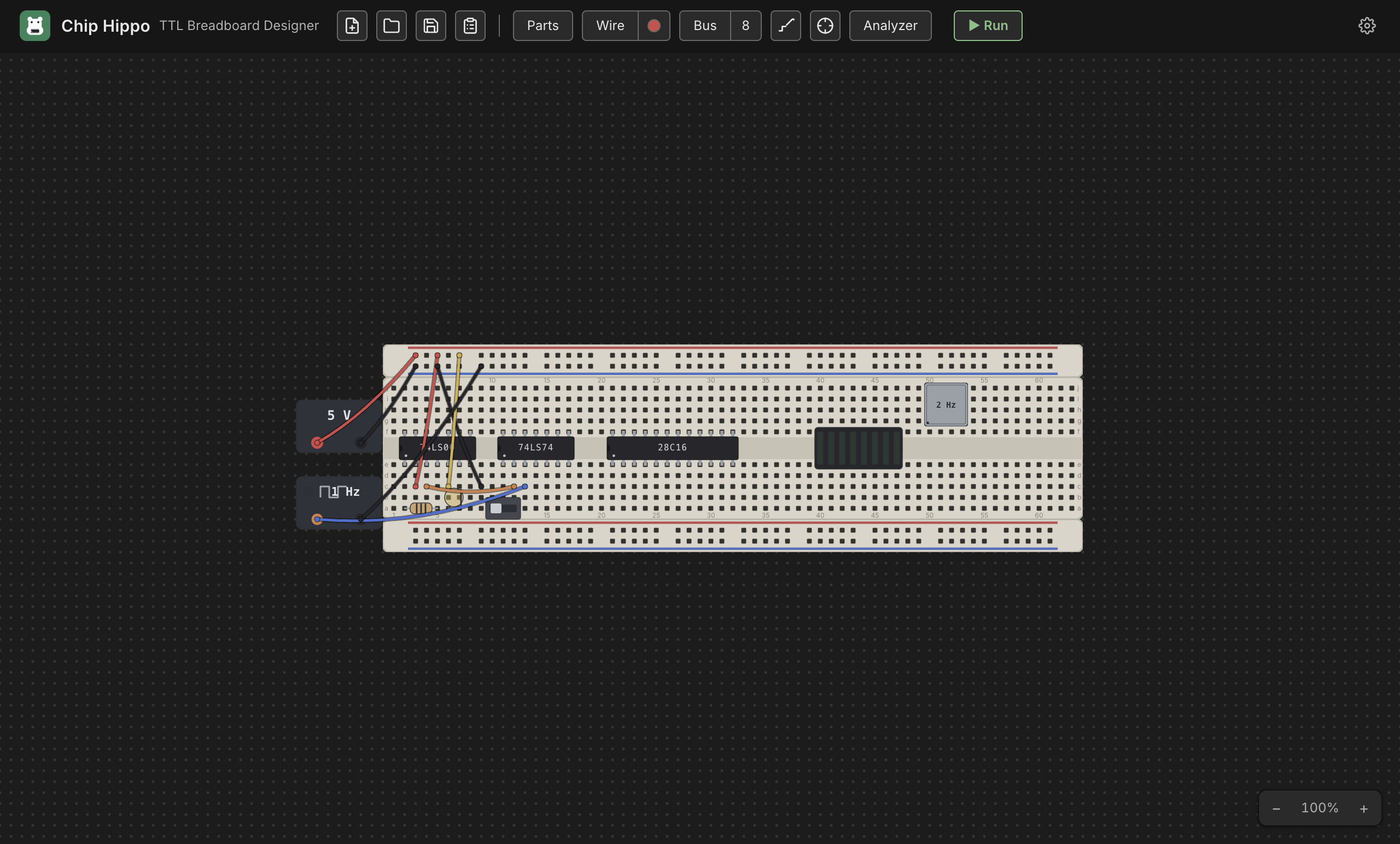
Chip Hippo is a desktop app for designing and simulating 74xx TTL logic circuits on virtual solderless breadboards. Place a breadboard on the infinite desk, populate it with 74xx DIP chips, wires, switches, LEDs, and power sources, then press Run — a simulation engine traces electricity from every power source, resolves each electrical net, and ripples changes through the circuit exactly like a real breadboard would.
What you can build
Anything a 74xx TTL breadboard bench can hold: combinational logic (gates, decoders, multiplexers), sequential logic (flip-flops, counters, shift registers), a free-running or manually stepped clock, and small memory circuits backed by ROM/RAM chips — all wired across Full/Half/Tiny breadboards, powered at 3 V / 5 V / 12 V, and watched settle live. Beyond the 74xx shelf there is a PROCESSOR group — a W65C02 and a Zilog Z80A, each a full instruction-set simulation — and an Interface group of 65xx peripherals (a PIA and a VIA), for building a small single-board computer out of the same glue logic.
Highlights
- Breadboard-accurate placement — chips, wires, and discretes snap to the real 0.1 in hole grid, with the same row-half/trench/rail tie-point rules as a physical board.
- Live simulation — Run the circuit and watch LEDs light, chip health badges report power/damage state, and switches drive the circuit live.
- Deep inspection tools — a connectivity probe, net names/labels, and a logic analyzer for capturing waveforms.
- Memory chips with a hex inspector — file-backed ROM/EEPROM images you program with an in-app programmer, plus a live hex/ASCII viewer.
- A derived schematic view — press
Tabto flip between the physical breadboard and a logical diagram of chip symbols, routed named nets, and bus lines, kept in sync with the desk. - Build guide & BOM export — including a numbered cutting list of every jumper — and undo/redo across every edit, per desktop of the open project.
- Seven languages — English, German, Spanish, French, Italian, Japanese and Chinese, chosen in Settings ▸ Appearance (this guide is English only).
- An AI circuit builder — describe a circuit in words, using your own AI connection, and get a wired design that has already been built and run before you're offered it.
Table of contents
Getting started
- Getting Started — install the app, place your first board and chip, and run your first circuit.
Building a circuit
- The Desk & Breadboards — pan/zoom, breadboard kits, strips and rails, snapping and grouping.
- Chips & Components — the parts palette, DIP chips, discretes, placement and rotation.
- Wiring, Nets & Buses — the wire tool, colors, cross-board wires, and multi-bit buses.
- Power & Clock Sources — PSU bricks, voltage and the 12 V damage rule, and clock sources.
- The Chip Library — the catalog: 74xx logic, memory, the 65xx interface parts and the CPUs, and the pin-assignments/datasheet window.
Simulating & inspecting
- Running a Simulation — Run/Stop/Pause/Step, the settle model, and live views.
- Probing & Net Names — the connectivity probe and naming nets.
- Memory Chips & the Inspector — ROM/RAM, the programmer, and the hex/ASCII inspector.
- Logic Analyzer & Timing — capturing and reading waveforms.
- Schematic View — the derived logical diagram.
- AI Circuit Builder — describe a circuit in words and get a simulation-proven design, using your own AI connection.
Files & reference
- Build Guide & BOM — deriving a bill of materials, a jumper cutting list, and an ordered assembly checklist.
- Files, Saving & Undo — where a desktop and a project are kept, saving them, and undo/redo.
- Projects & Desktops — tabbed desktops, saving a project, and copying a design from one desktop onto another.
- Settings — the settings dialog and its options.
- Keyboard Shortcuts — every shortcut in one place.